)
)
)
What’s Next for Legal Practice - And How Teams Are Getting There
Legal innovation is often framed around technology - what’s new, what’s next, and what tools firms should be adopting.
But as the profession continues to evolve, it’s becoming clear that the real shift goes beyond the tools themselves. It’s about how people respond, how teams operate, and how firms approach changes more broadly.
That raises some important questions. How do we ensure new ways of working actually stick? What skills will matter most as the profession evolves? And how do we move forward with clarity - not just speed?
Ahead of the event, we spoke with a few of our incredible speakers to get their perspectives.
Angela Luu, Senior Manager, AI Enablement, Herbert Smith Freehills Kramer & Ena Catovic, Manager, AI Enablement, Herbert Smith Freehills Kramer
Can you tell us a little about your session and what attendees can expect to take away?
We work in AI enablement at a global law firm, so our whole world revolves around making change stick. What we've learned (sometimes the hard way) is that the biggest barrier to adoption isn't the technology. It's everything around it. The habits, the culture, the communication, the leadership signals.
This session is an invitation to slow down and come back to some fundamentals. Not a new framework or a big reveal. What we want to do is create a bit of space to reflect on what's actually happening in our teams, share what we're seeing, and think about what small, realistic shifts might actually move the needle. We're hoping people leave feeling like they got something practical – not more to add to an already full plate, but a few things they can quietly start doing differently.
What changes are you seeing in how legal teams across Australia are adopting technology or new ways of working?
Something genuinely exciting about this AI moment is that it's sparked a kind of curiosity in the legal profession that we haven't really seen before. Historically, technology adoption in legal has been quite structured. A system gets introduced, people are trained on it, it becomes part of the workflow (if we’re lucky). With AI it's different. People are exploring and trying things, sharing what they found with colleagues.
That shift in behaviour might sound small. It isn’t. Curiosity is one of the core human skills that underpins all learning and change. It's also fragile. It needs the right conditions to survive contact with a busy law firm. The organisations that are deliberately designing for it, building it into how they run training, how leaders show up, how they communicate change are likely to pull ahead.
What's one misconception about legal innovation you'd most like to challenge?
That when something isn't working, the solution needs to be better.
Adoption is low so the training and comms need to be more frequent. The tool isn't delivering so we need a different one. There's a tendency to keep iterating on the output without stopping to question whether we understood the problem in the first place.
We had a version of this ourselves. We spent weeks perfecting a guide for partners. Nobody read it. When we actually spoke to one partner, she told us she didn't open anything about AI anymore – the volume was just too much. What would make her open it was a hook. We'd been refining the content when we hadn't understood where she was starting from. One conversation changed the whole approach.
The instinct to do more is a natural one. But sometimes the most useful thing is to pause and check you're solving the right problem.
Jeanette Merjane, Legal Transformation Analyst and Accredited Specialist in Family Law, Lander & Rogers
Can you tell us a little about your session and what attendees can expect to take away from it?
This session focuses on the human element of practising law in a technology-enabled profession. It draws insights from what is currently happening in the tertiary space, including how law students and graduates are being trained to adapt to the technological and structural changes reshaping legal practice.
The session will feature a candid conversation between a lawyer and a law student, exploring expectations, anxieties, and opportunities from both perspectives. There’s a strong focus on skills rather than tools, recognising that firms are all at different stages of their technology journey. This includes areas such as AI fluency, digital literacy, ethics, judgement, and the human capabilities that will matter even more as technology continues to accelerate.
Attendees will leave with a practical roadmap to prepare for 2030, helping them think more clearly about how to build future-ready skills in a rapidly changing environment.
What changes are you seeing in how legal teams across Australia are adopting technology or new ways of working?
One of the biggest shifts is that lawyers are no longer sitting on the sidelines of innovation. In many organisations, legal teams are now working directly with innovation and technology teams, helping shape solutions rather than simply reacting to them.
There’s also a growing willingness to experiment. Lawyers are increasingly engaging in pilots and trials and becoming part of the decision-making process, rather than waiting for perfect, enterprise-wide solutions to be rolled out.
What’s one misconception about legal innovation you would most like to challenge?
A common misconception is that AI means lawyers won’t need to learn core competencies anymore. In reality, lawyers will continue to learn, just as they always have. AI is changing how lawyers learn, not whether they learn.
Core competencies still matter, but they are showing up differently in practice. At the same time, AI is creating new opportunities to teach and mentor lawyers in ways that haven’t been possible before.
Karen Lee, Regional Lead Counsel – JAPAC at Clinigen | Chair of Association of Corporate Counsel Australia Legal Tech and Innovation community
Can you tell us a little about your session and what attendees can expect to take away from it?
This session shares about what actually happens when we implement AI contract review in an in-house environment. This is not just theory, but the learnings and friction points that don’t show up in demos.
In practice, the hard work is around implementation and change management and the surprising level of discipline required to generate useful outputs and increase efficiency. I will share about what didn’t work as expected when we implemented a tech tool across a global legal function, and what we had to change to make it effective.
Attendees will walk away with practical steps for preparation before rollout and watchouts during implementation.
What changes are you seeing in how legal teams across Australia are adopting technology or new ways of working?
What has changed in the in-house environment is the shift from curiosity to expectation. Previously lawyers and teams were experimenting with AI. Now there are inherent assumptions within organisations that we should be using AI, and also using it well.
What is very interesting is how inhouse teams are being pushed to define their thinking more clearly. For example, tech implementation help to expose inconsistencies that may always have been there such as variations in how different lawyers approach the same issue or have institutional knowledge that are within their heads. Adoption is now no longer just about choosing the right tool, but it is about driving a level of standardisation, transparency and discipline in legal work that teams historically haven’t needed to formalise.
What’s one misconception about legal innovation you would most like to challenge?
What I have seen is that a common misconception is that legal innovation is all about the technology, so the first question teams ask is often “what AI tool should we adopt?”. In reality, many inhouse teams struggle with first clearly identifying the problem they are trying to solve, or to clarify underlying internal processes. AI doesn’t solve these issues but rather amplifies them.
The real work for innovation isn’t adopting new tools. It is less visible and often more comfortable. It is about doing the harder work of defining how inhouse legal teams think and operate and structuring and organising our data and institutional knowledge in a way that AI can actually use and ensuring that it reflects a consistent and deliberate approach to risk management.
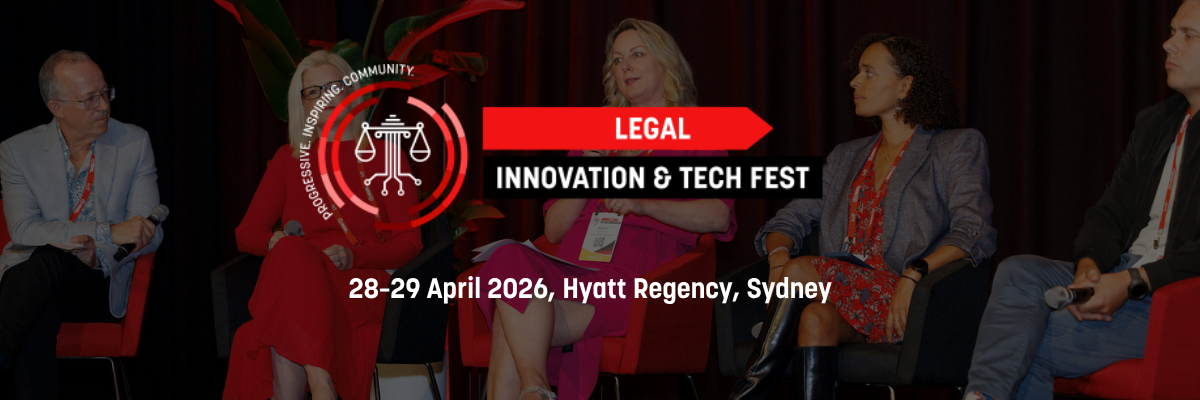
With two days of practical insights, real-world examples and honest conversations, Legal Innovation & Tech Fest Australia is your opportunity to explore the ideas, technologies and approaches shaping the future of the legal profession.
Join a community of legal leaders, practitioners and innovators as we unpack what’s next for legal practice, innovation and client service.
28-29 April | Hyatt Regency Sydney
This is an event not to be missed.
Secure your tickets online or contact us today.
)
)
)
)